
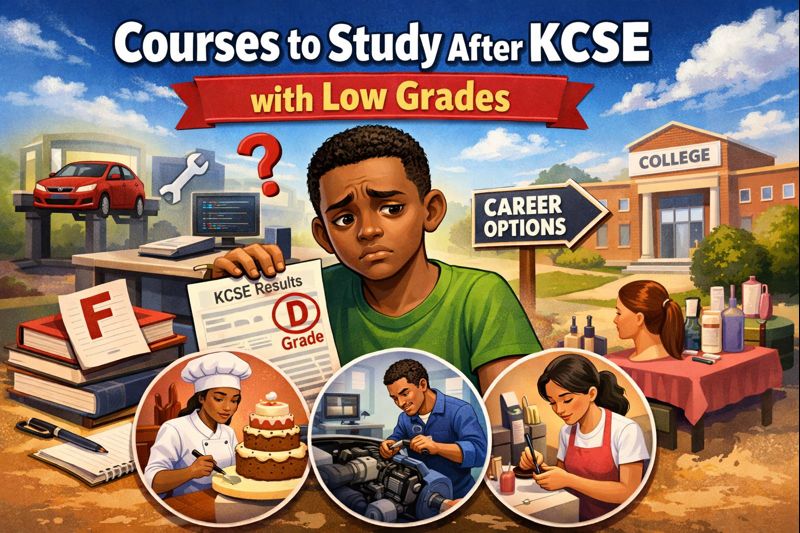
Scoring low grades in KCSE can feel discouraging, but it does not mean the end of your education or career prospects. There are numerous courses to study after KCSE with low grades that lead to successful careers and self-employment opportunities in Kenya.
Every year, thousands of students score D+, D, C-, or C Plain in KCSE and go on to build thriving careers through alternative education pathways. The key is knowing which courses are available, where to study them, and how these qualifications can help you achieve your goals.

This guide provides comprehensive information about KCSE D+ courses in Kenya, courses for C- students in Kenya, colleges accepting low KCSE grades, and practical alternatives after KCSE in Kenya.
Whether you scored a D or C-, this guide will help you discover valuable education and career pathways that match your situation and ambitions.

What Are Courses for Students with Low KCSE Grades?
These are certificate, diploma, and vocational training programs offered by TVET institutions, technical colleges, private colleges, and vocational centers that accept students who scored below C+ in KCSE.
Low grades typically refer to D, D+, C-, and C Plain. Each grade opens different course opportunities.
These courses focus on practical skills rather than academic theory, preparing students for immediate employment or self-employment. Many successful Kenyan entrepreneurs and professionals started their journeys through these alternative education pathways.
Who Should Consider These Courses?
- KCSE candidates who scored D, D+, C-, or C Plain
- Students who prefer hands-on learning over theoretical studies
- Young people who want to start earning quickly
- Those interested in technical and vocational careers
- Students whose families cannot afford university education
- Anyone seeking practical skills for self-employment
Why Courses for Low KCSE Grades Are Important
Alternative education pathways are crucial for youth employment and national development in Kenya.
Practical Job Market Value
Kenya faces a severe shortage of skilled technicians, artisans, and craftspeople. Industries like construction, manufacturing, hospitality, and agriculture constantly need workers with practical skills rather than academic qualifications.
Many employers prefer hiring TVET graduates because they have hands-on experience and can start working immediately without extensive training.
Self-Employment Opportunities
Courses accepting low KCSE grades teach marketable skills. A student with training in plumbing, electrical work, tailoring, hairdressing, or welding can start earning income immediately after completing their course.
Many successful business owners in Kenya never went to university. They built profitable enterprises using skills learned in technical colleges and vocational centers.
Government Recognition and Support
The Kenyan government recognizes that not every student will score high grades in KCSE. Through TVETA and various funding programs, the government has created pathways for all students to access quality education and training.
County governments also offer scholarships and bursaries specifically for students pursuing technical and vocational courses, recognizing their importance to local economies.
Affordable Education
These courses cost significantly less than university programs. Many can be completed in six months to two years, meaning students start earning much sooner than university graduates who study for four or more years.
Requirements for Different KCSE Grade Levels
Understanding what you can study with your specific KCSE grade helps you plan effectively.
With KCSE D (Plain):
- Artisan certificate courses in trades
- Short vocational courses (3-6 months)
- Basic skills training programs
- Youth Polytechnic courses
- Some private college certificate programs
- Community-based training programs
With KCSE D+ (Plus):
- Craft certificate courses at TVET institutions
- Technical training in various trades
- Certificate courses in ICT
- Certificate courses in hospitality
- Certificate in business studies
- Beauty and hairdressing courses
- Automotive mechanics courses
- Agriculture certificate programs
With KCSE C- (Minus):
- Diploma courses in most fields at TVET colleges
- Certificate and diploma in teaching (ECD teachers)
- Nursing assistant training
- Clinical medicine certificates at some institutions
- Journalism and media diplomas
- Business management diplomas
- Hotel management diplomas
- ICT diplomas
With KCSE C (Plain):
- Wide range of diploma programs
- Higher National Diplomas
- Some degree programs at private universities
- Professional courses like CPA, ACCA (with hard work)
- Teaching diploma programs
- Bridging programs to university
General Requirements:
- Original KCSE certificate or result slip
- National ID or birth certificate
- Passport photographs
- Medical certificate (for some courses)
- Registration and examination fees
- Age requirements vary by course (usually 15+ years)
Some institutions offer bridging courses or foundation programs for students who need to strengthen their academic background before starting their main course.
Best Colleges Accepting Low KCSE Grades
Kenya has numerous institutions that welcome students with D, D+, C-, and C grades.
Government TVET Institutions:
National Polytechnics:
- Kenya Polytechnic, Nairobi
- Mombasa Polytechnic
- Kisumu National Polytechnic
- Eldoret National Polytechnic
- Kitale National Polytechnic
- Coast National Polytechnic
- Kabete National Polytechnic
Technical Training Institutes:
- Kenya Medical Training College (some campuses)
- Kenya Institute of Mass Communication
- Kenya School of Government
- Industrial Training Centers across counties
- Government Technical Training Institutes
Youth Polytechnics:
- Located in almost every constituency
- Offer very affordable artisan training
- Accept students with D and D+ grades
- Focus on practical community-relevant skills
Private Middle-Level Colleges:
- St. Kizito VTC, Nairobi
- Don Bosco Youth Technical Institute
- Gretsa University College
- Kenya School of Professional Studies
- PC Kinyanjui Technical Training Institute
- Rift Valley Institute of Science and Technology
- Ramogi Institute of Advanced Technology
Colleges for Specific Fields:
Hospitality and Tourism:
- Kenya Utalii College (C- and above)
- Various hotel training institutes
- Tourism colleges in coastal regions
ICT and Technology:
- Jomo Kenyatta University TVET Institute
- ICT centers and computer colleges
- Digital training centers
Beauty and Fashion:
- Beauty therapy colleges in major towns
- Fashion design institutes
- Tailoring and dressmaking centers
Agriculture:
- Agricultural Training Centers (ATCs)
- Farmer Training Centres
- County agricultural colleges
Religious and Community-Based Institutions:
- Catholic, Anglican, and other church-run training centers
- NGO-sponsored training programs
- Community polytechnics
These institutions offer quality training at affordable costs and have good connections with employers in their regions.
Popular KCSE D+ Courses in Kenya
Students with D+ can access various certificate and craft-level courses.
Engineering and Construction:
- Electrical installation (house wiring, industrial)
- Plumbing and pipe fitting
- Welding and metal fabrication
- Carpentry and joinery
- Masonry and bricklaying
- Motor vehicle mechanics
- Refrigeration and air conditioning
ICT Courses:
- Computer packages (Microsoft Office)
- Hardware maintenance and repair
- Web design basics
- Graphic design
- Digital marketing fundamentals
- Cyber security basics
Business and Office Skills:
- Business management certificate
- Sales and marketing
- Customer care and front office
- Secretarial studies
- Entrepreneurship training
- Bookkeeping and accounts
Hospitality and Food:
- Food and beverage production
- Catering and accommodation
- Bakery and confectionery
- Waitering and bar operations
- Housekeeping
Beauty and Fashion:
- Hairdressing and barbering
- Beauty therapy
- Nail technology
- Makeup artistry
- Tailoring and dressmaking
- Fashion design basics
Agriculture:
- Crop production
- Poultry farming
- Dairy farming
- Greenhouse farming
- Animal health
Others:
- Driving (personal and commercial)
- Security management
- Courier and logistics
- Tour guiding basics
Courses for C- Students in Kenya
C- grade opens opportunities for diploma-level training in numerous fields.
Medical and Health Sciences:
- Kenya Enrolled Community Health Nurse
- Pharmacy technician
- Medical laboratory technician
- Nutrition and dietetics
- Health records management
- Occupational health and safety
- Dental technology
Education:
- Early Childhood Development and Education (ECDE)
- Primary teacher education (some colleges)
- Special needs education
- Educational technology
Business and Finance:
- Business management diploma
- Human resource management
- Supply chain management
- Banking and finance
- Accounting (for CPA track)
- Insurance and risk management
- Marketing and sales management
Engineering and Technology:
- Electrical and electronic engineering
- Mechanical engineering
- Civil engineering
- Automotive engineering
- Telecommunications engineering
- Building and construction
ICT Diplomas:
- Information technology
- Software engineering
- Network administration
- Cyber security
- Database management
- Digital media and animation
Hospitality and Tourism:
- Hotel and restaurant management
- Food and beverage management
- Tour operations management
- Travel and tour guiding
- Event management
Media and Communication:
- Journalism and mass communication
- Public relations
- Broadcasting (radio and TV)
- Film and video production
- Photography
Agriculture and Environment:
- Agricultural extension
- Agribusiness management
- Horticulture
- Animal health and production
- Environmental management
Fashion and Interior Design:
- Fashion design and garment technology
- Interior design
- Textile design
Duration and Fees for Different Courses
Course duration and costs vary based on level and institution.
Artisan Certificates (D Grade):
- Duration: 6 months to 1 year
- Government institutions: KES 10,000 – KES 25,000 per year
- Private institutions: KES 20,000 – KES 50,000 per year
- Tools and materials: KES 5,000 – KES 15,000
Craft Certificates (D+ Grade):
- Duration: 1 to 1.5 years
- Government institutions: KES 18,000 – KES 40,000 per year
- Private institutions: KES 30,000 – KES 70,000 per year
- Additional costs: KES 10,000 – KES 20,000
Diploma Courses (C- Grade):
- Duration: 2 to 3 years
- Government institutions: KES 35,000 – KES 70,000 per year
- Private institutions: KES 50,000 – KES 150,000 per year
- Books and materials: KES 5,000 – KES 15,000 per year
Short Courses and Certifications:
- Duration: 1 to 6 months
- Cost: KES 5,000 – KES 50,000 depending on course
- Examples: driving, first aid, computer packages
Additional Expenses:
- Accommodation (if boarding): KES 15,000 – KES 40,000 per term
- Meals (if not included): KES 8,000 – KES 15,000 per month
- Transport: KES 2,000 – KES 10,000 per month
- Industrial attachment: KES 5,000 – KES 15,000 total
Funding Options:
- HELB loans for diploma students
- County government bursaries
- National Government CDF bursaries
- NGO scholarships
- KYEOP free training for vulnerable youth
- Installment payment plans at most institutions
Career Opportunities and Self-Employment
Graduates of these courses have numerous pathways to earning income.
Employment Opportunities:
Technical Fields:
- Electrician in companies or government: KES 15,000 – KES 40,000
- Plumber in construction firms: KES 12,000 – KES 35,000
- Mechanic in garages: KES 15,000 – KES 35,000
- Welder in manufacturing: KES 18,000 – KES 40,000
- Carpenter in furniture companies: KES 12,000 – KES 30,000
ICT Sector:
- Computer technician: KES 18,000 – KES 40,000
- Cyber café attendant: KES 12,000 – KES 25,000
- IT support assistant: KES 20,000 – KES 45,000
Hospitality:
- Chef or cook: KES 15,000 – KES 40,000
- Waiter/waitress: KES 12,000 – KES 25,000
- Housekeeping supervisor: KES 15,000 – KES 30,000
- Baker: KES 15,000 – KES 35,000
Healthcare:
- Enrolled nurse: KES 25,000 – KES 50,000
- Pharmacy technician: KES 20,000 – KES 45,000
- Medical lab technician: KES 25,000 – KES 55,000
Self-Employment Options:
Starting your own business with practical skills:
- Electrical repair services: KES 20,000 – KES 150,000 monthly
- Plumbing business: KES 25,000 – KES 120,000 monthly
- Welding and fabrication workshop: KES 30,000 – KES 200,000 monthly
- Mechanic garage: KES 40,000 – KES 250,000 monthly
- Salon or barbershop: KES 20,000 – KES 100,000 monthly
- Tailoring business: KES 15,000 – KES 80,000 monthly
- Catering services: KES 30,000 – KES 200,000 monthly
- Computer repair shop: KES 20,000 – KES 100,000 monthly
- Cyber café: KES 25,000 – KES 80,000 monthly
Income Growth Potential:
Entry-level earnings may be modest, but with experience and good reputation, income grows significantly. Many self-employed graduates earn more than university graduates in their first five years.
Location matters greatly. Urban areas offer higher income but have more competition. Rural areas have less competition but may have fewer customers.
Alternatives After KCSE in Kenya
Beyond formal courses, several alternative pathways exist.
Apprenticeship and On-Job Training:
- Learn while earning with experienced professionals
- Common in trades like carpentry, welding, tailoring
- Duration: 6 months to 2 years
- May lead to formal certification through Recognition of Prior Learning (RPL)
Online Courses and Certifications:
- Learn digital skills through platforms like Ajira Digital
- Google Digital Skills (free)
- Coursera and edX certificates
- YouTube tutorials for practical skills
- Cost: Free to KES 50,000
Short-Term Professional Courses:
- First aid certification
- Driving school
- Security training
- Tour guiding
- Barista training
- Basic photography
Youth Programs:
- National Youth Service (NYS) offers training and stipend
- Kenya Youth Employment and Opportunities Project (KYEOP)
- Youth Enterprise Development Fund training
- County government youth programs
Starting Small Business:
- With minimal training, start businesses like:
- Selling agricultural produce
- Operating a kiosk
- Mobile money agent
- Boda boda business
- Hawking goods
- Learn through experience and mentorship
Repeating KCSE:
- Some students choose to repeat KCSE as private candidates
- Costs KES 5,000 – KES 15,000 for registration
- Can improve specific subject grades
- Requires discipline and self-study
Religious and Mission Training:
- Bible colleges
- Islamic studies
- Mission training centers
- Often combine spiritual with practical skills training
Pros and Cons of Studying with Low KCSE Grades
Understanding both sides helps you make realistic decisions.
Advantages:
- Immediate access to practical, marketable skills
- Lower education costs than university
- Shorter training duration (earn money sooner)
- High demand for technical skills in Kenya
- Strong foundation for self-employment
- Hands-on learning suits many students better
- Government support and funding available
- Can upgrade gradually (certificate to diploma to degree)
- Less academic pressure and competition
- Real-world work experience through attachments
- Skills remain valuable throughout your career
- Can start earning while peers are still in university
Disadvantages:
- Social stigma about low grades persists
- Some people wrongly view technical education as inferior
- Limited direct entry to university
- Fewer scholarship opportunities than high performers
- Some careers remain closed (medicine, law, engineering degrees)
- Physical demands of many technical courses
- May require purchasing tools and equipment
- Workshop safety risks if not careful
- Some employers still prefer university degrees
- Lower starting salaries than degree holders (initially)
- Gender stereotypes in some technical fields
- Family and social pressure to repeat KCSE
Despite these challenges, thousands of Kenyans have built successful careers and businesses starting with D or C grades in KCSE.
Frequently Asked Questions (FAQ)
What can I study with D+ in KCSE?
With D+ you can study craft certificate courses at TVET institutions including electrical installation, plumbing, welding, carpentry, motor vehicle mechanics, ICT certificates, business certificates, hospitality courses, beauty and hairdressing, and agriculture programs. These courses take 1-1.5 years and lead to employment or self-employment opportunities.
Which colleges accept D plain in KCSE?
Youth Polytechnics across Kenya, government technical training institutes, some private vocational colleges, and community-based training centers accept students with D plain. These institutions offer artisan-level courses in basic trades like masonry, tailoring, driving, and agricultural skills.
Can I become a nurse with C- in KCSE?
Yes, with C- you can train as a Kenya Enrolled Community Health Nurse at Kenya Medical Training College and other registered nursing schools. This is different from registered nursing which requires higher grades. Enrolled nurses work in hospitals, clinics, and community health programs with good salaries.
Is it better to repeat KCSE or join college with low grades?
This depends on your situation. If you narrowly missed your target grade and have time and resources, repeating might help. However, joining college and gaining practical skills often leads to faster employment and income. Many successful Kenyans never repeated KCSE but built careers through alternative pathways.
How can I get funding for TVET courses with low grades?
Apply for HELB loans if joining diploma programs, contact your county government for bursaries and scholarships, apply for CDF bursaries through your MP’s office, check for NGO scholarships, inquire about KYEOP free training programs, or ask institutions about installment payment plans.
Can I upgrade from certificate to diploma to degree?
Yes, Kenya’s education system allows vertical progression. After completing a certificate, you can join diploma programs. After diploma, you can join university for degree programs, often with credit transfers that reduce study duration. This pathway takes longer but is achievable.
Which course guarantees employment after KCSE with low grades?
No course absolutely guarantees employment, but courses in high demand include electrical installation, plumbing, ICT, enrolled nursing, hospitality, and welding. Success depends on skill quality, attitude, networking, and sometimes location. Self-employment through these skills often provides better income than formal employment.
What if my parents insist I must go to university?
Have an honest conversation about your options. Show them this guide and explain that technical skills lead to good careers. Many parents worry because they don’t understand TVET education. Consider starting with a diploma and upgrading to degree later, or demonstrate commitment by excelling in your chosen technical course.
Final Thoughts
Scoring low grades in KCSE is not the end of your education journey or career prospects. The courses to study after KCSE with low grades offer practical pathways to employment, self-employment, and financial independence.
Kenya needs skilled technicians, artisans, and craftspeople more than it needs more unemployed degree holders. Technical and vocational education provides relevant skills that immediately address market needs.
Success depends not on your KCSE grade but on your attitude, dedication, and willingness to learn practical skills. Many wealthy and successful Kenyans started with modest KCSE grades but excelled through technical training and entrepreneurship.
Research your options carefully, choose courses matching your interests and local market demand, and commit fully to your training. With the right skills and mindset, you can build a successful and fulfilling career regardless of your KCSE performance.
Your future is not determined by exam scores but by the decisions and efforts you make starting today.






Leave a Comment