

Quick Key Takeaways
- A marketable course is one that leads to real employment or income — not just a certificate
- Kenya’s job market rewards both academic qualifications AND practical skills
- Government, private sector, and self-employment are all valid end goals — your course should align with one
- Research before you enroll — not after
- A “popular” course is not always a “marketable” course
Why Choosing the Right Course in Kenya Is a Big Decision
Learning how to choose a marketable course in Kenya is one of the most important things a student or career changer can do before spending time and money on education. Every year, thousands of Kenyan students enroll in courses under peer pressure, parental expectations, or simply because a course “sounds good” — and end up graduating into a job market with no space for them.
The hard truth is that Kenya’s unemployment rate among graduates is stubbornly high, not because people lack education, but because many studied courses that don’t match what the economy actually needs. The good news is that with the right information and honest self-reflection, you can make a course choice that genuinely sets you up for a career, not just a certificate.

This guide walks you through exactly how to do that.
What Does “Marketable” Actually Mean in Kenya’s Context?
Before diving into steps and strategies, it is important to define what is meant by “marketable” in the Kenyan context, as it is often misunderstood.

A marketable course is one where the skills or qualifications it produces are in active demand — by employers, clients, or the market in general. It does not necessarily mean the most glamorous course or the one with the longest name. It means the one that creates real, sustainable pathways to income.
In Kenya, marketability shows up in three main ways: formal employment (getting hired by a company, government, or organization), self-employment or freelancing (using a skill to earn independently), and further education that leads to higher-paying specializations. A truly marketable course should open at least one of these doors clearly.
Read also: Marketable Diploma Courses in Kenya: Complete Guide 2026
Step-by-Step: How to Choose a Marketable Course in Kenya
Step 1: Honestly Assess Your Strengths and Interests
This step is the one most Kenyan students skip — and it is the most important one. Before looking at any course brochure, sit down and ask yourself what subjects or activities you have consistently done well in or genuinely enjoyed. Are you analytical? Do you enjoy working with people? Are you good with your hands? Do you like solving technical problems?
A career built on something you are naturally inclined toward is far more sustainable than one chosen purely for salary expectations. Someone who loves biology and human health will thrive in a healthcare course in ways that someone who enrolled just because “medicine pays well” might not.
Honest self-assessment is not about limiting yourself — it is about giving yourself the best possible starting foundation.
Step 2: Research Kenya’s Current and Future Job Market
This is where many students put the cart before the horse. They choose a course and then hope jobs will be there. The smarter approach is to look at where Kenya’s economy is heading and then choose a course that positions you inside that growth.
In recent years, Kenya’s high-growth sectors have included technology and digital services, healthcare and public health, agribusiness and food systems, financial services and fintech, renewable energy, construction and infrastructure, and logistics and supply chain. These sectors are being driven by government investment, foreign direct investment, and the growing needs of Kenya’s young, urbanizing population.
Future careers in Kenya that are showing consistent growth include software developers, data analysts, cybersecurity specialists, nurses and clinical officers, agricultural extension officers, civil and structural engineers, supply chain managers, and digital marketers. If a course feeds directly into one of these roles, it earns strong marketability points.
Step 3: Check Graduate Employability Data, Not Just Reputation
This is a step very few students in Kenya take, and it is a powerful differentiator. Instead of choosing a university or course based on prestige alone, ask one specific question: what percentage of graduates from this course get employed within one year of graduating?
Some universities publish this data. Others do not. If they don’t, that itself tells you something. You can also speak to alumni — LinkedIn is a surprisingly useful tool for this. Search for people who graduated from the course you are considering and look at where they are working now. If most of them are in relevant fields and progressing, that is a strong green flag. If most of them list their job as “seeking opportunities” three years after graduation, take note.
Employable skills in Kenya are increasingly being measured not by the name of the institution but by the actual competencies a graduate can demonstrate on day one of a job.
Step 4: Distinguish Between Saturated and Undersupplied Fields
Some courses in Kenya are so popular that the market is genuinely flooded. This does not mean you cannot succeed in them, but it does mean you need to go in with clear eyes. Law, business administration, and basic IT courses are examples of fields where the number of graduates has significantly outpaced the number of available formal jobs.
On the other side, there are fields that Kenya consistently struggles to fill. Clinical engineering, orthopaedic technology, health informatics, water resource management, geospatial technology, and certain areas of agriculture and food science are areas where qualified graduates are harder to find than employers would like. Choosing an undersupplied field, especially one that aligns with your interests, can dramatically improve your employment odds.
The point is not to avoid popular courses at all costs — a highly driven student can succeed in a competitive field. The point is to know exactly what you are entering so you can plan accordingly.
Step 5: Factor in Self-Employment and the Gig Economy
Kenya’s formal employment sector cannot absorb everyone, and this is not a new problem. The smarter frame for choosing a course in 2024 and beyond is to ask: can the skills from this course also be used to generate income independently?
Courses in graphic design, software development, digital marketing, photography, nutrition and dietetics, electrical engineering, plumbing, and even accounting lend themselves to freelancing, consulting, or running a small business. The rise of platforms like Upwork, Fiverr, and local digital marketplaces means that employability in Kenya no longer depends entirely on a formal employer handing you a job offer.
If a course only makes sense if someone hires you, and hiring in that field is slow, then the course carries more risk. If the course skills can be monetized independently as well, the risk is considerably lower.
Step 6: Consider the Cost-to-Return Ratio
This is a practical financial calculation that most Kenyan families and students rarely do formally, but it matters enormously. How much will this course cost in total — fees, accommodation, living expenses — and what is the realistic salary expectation upon graduation?
A four-year private university degree, costing Ksh 600,000 to Ksh 1,000,000, in a field where starting salaries are Ksh 20,000 per month, is a very different financial decision from a two-year KMTC certificate, costing Ksh 100,000, that leads to a stable county government job at Ksh 30,000 per month.
Neither is automatically better — but doing the calculation consciously helps you choose a path that makes financial sense for your family’s situation. Government-sponsored courses under KUCCPS are obviously more affordable, and prioritizing government sponsorship for degree-level education is a sensible strategy where possible.
Step 7: Look at KUCCPS Cluster Points and Requirements Honestly
For students coming straight from KCSE, the Kenya Universities and Colleges Central Placement Service (KUCCPS) system is the gateway to public university education. Being realistic about your cluster points and the cut-off scores for specific courses is not defeatist — it is strategic.
If your grades place you in a certain range, there are still excellent and marketable courses available. Engineering, nursing, information technology, education, agriculture, and business-related courses have varying cut-off points, and there is usually a realistic option within your score range that leads somewhere meaningful. The mistake is forcing your way into a course through a private university at great expense just because “everyone wants that course” when a more accessible course in a genuinely high-demand field is available.
A career decision guide for Kenya must account for this reality — your grades are a starting point for planning, not a final verdict on your potential.
Read also: TVET Courses and Fees in Kenya: Complete Guide for Students and Parents
College Course Advice: Common Mistakes Kenyan Students Make
Understanding how to choose well also means understanding how choices go wrong. These are the most common mistakes in the Kenyan context:
Following friends is probably the single biggest driver of poor course choices. Your friends’ strengths, financial situations, and career goals are not the same as yours. A course that suits your friend perfectly may be a poor fit for you.
Choosing based on prestige alone leads many students into law and medicine without considering whether they can realistically meet the academic demands or handle the realities of the careers. Prestige and marketability are not the same thing.
Ignoring technical and vocational options is a deeply ingrained bias in Kenyan culture. Many families push for university degrees even when a technical or TVET qualification would lead to faster employment and a similar or better income. An electrician, plumber, or automotive technologist with proper qualifications can earn extremely well in Kenya — often more than a desk-bound degree holder.
Not researching the institution’s accreditation is a critical error, particularly with private colleges. Always verify that the institution is accredited by the relevant authority — Kenya National Qualifications Authority (KNQA), the Commission for University Education (CUE), or the relevant professional body for your field.
Marketable Courses Worth Considering in Kenya Right Now
Based on current labor market trends and the structure of Kenya’s growing economy, these are courses with strong marketability signals across different grade levels and financial situations:
In technology, software development, data science, cybersecurity, and cloud computing, there is strong demand from both local companies and international remote work opportunities. Even short professional certification courses from platforms like Coursera or Google Career Certificates carry real weight in this field.
In healthcare, nursing, clinical medicine, medical laboratory science, pharmaceutical technology, and community health, demand remains consistently high, particularly as Kenya expands its Universal Health Coverage program.
In agriculture and environment, agribusiness management, agricultural extension, environmental science, and food technology connect to Kenya’s core economic activities and are supported by ongoing government and donor investment.
In engineering and construction, civil engineering, electrical engineering, quantity surveying, and building technology are riding the wave of Kenya’s major infrastructure investments.
In education, early childhood development and primary education teaching remain undersupplied, particularly outside Nairobi, and teachers are among the most consistently employed professionals in the country.
The Role of Skills Beyond Your Certificate
One thing that the Kenyan job market has made increasingly clear is that a certificate or degree alone is no longer sufficient. Employers — particularly in the private sector — are looking for graduates who bring additional competencies: communication skills, digital literacy, problem-solving ability, and the initiative to keep learning.
Whatever course you choose, complement it intentionally. Learn basic data handling in Excel or Google Sheets. Build communication and presentation skills. Get certified in a relevant digital tool. Do internships and attachments seriously, not as a box-ticking exercise but as an opportunity to build real relationships and real skills.
Employable skills in Kenya’s modern job market are a combination of your formal qualifications and the practical, demonstrable competencies you build around them.
FAQ: Choosing a Marketable Course in Kenya
1. What is the most marketable course in Kenya right now? There is no single answer, as marketability depends on your skills, grades, and goals. However, technology-related courses, nursing and clinical medicine, engineering, and agribusiness consistently rank among the most in-demand fields across both formal employment and self-employment.
2. Is a degree better than a diploma or certificate for getting a job in Kenya? Not always. In technical fields like electrical work, medical technology, and information technology, diplomas and certificates from accredited institutions lead to solid employment. The key is the relevance and accreditation of the qualification, not the academic level alone.
3. How do I know if a private college course is legitimate in Kenya? Check accreditation with the Commission for University Education (CUE) for university-level programs or the Kenya National Qualifications Authority (KNQA) for other qualifications. For health-related courses, verify recognition by the relevant health regulatory body. Ask the institution directly for its accreditation documents and verify independently.
4. Can I change courses after enrolling at a Kenyan university? Yes, though the process depends on the institution and how early in your studies you are. Early transfer within your first year is generally more feasible. Speak to the registrar at your institution about transfer procedures and any academic or financial implications.
5. Are online courses and certifications valued by Kenyan employers? Increasingly, yes — especially in technology and digital marketing fields. Google, Microsoft, Coursera, and AWS certifications carry genuine weight with tech employers. However, for regulated professions like medicine, law, and engineering, formal accredited qualifications remain essential.
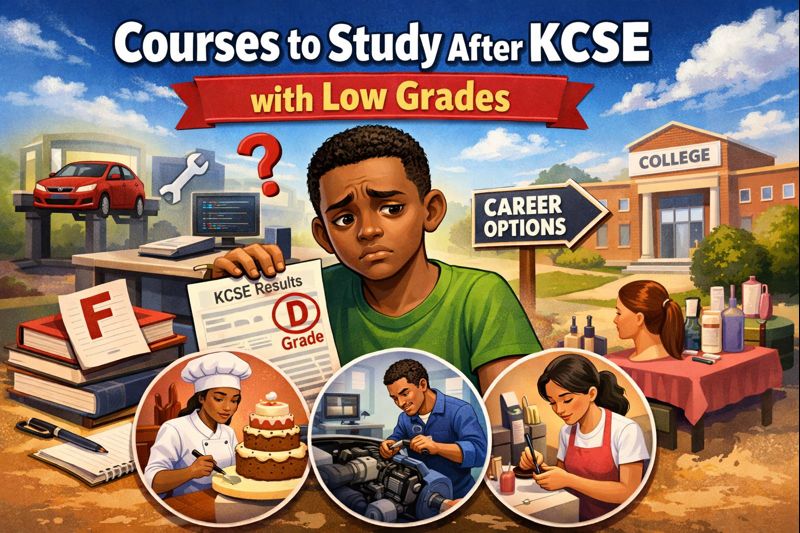
6. What should I do if my KCSE grades limit my course options? Start with what is accessible and plan for progression. KMTC certificate courses, TVET programs, and diploma pathways all offer routes into meaningful careers and can be upgraded over time. A D+ or C- today does not permanently determine your ceiling — many successful Kenyan professionals started with modest grades and built their careers through skill and persistence.
7. How important is the job market location when choosing a course in Kenya? Very important. If you plan to work in a specific county or region, research what employers and industries are dominant there. A course in fisheries management makes more sense if you intend to work in Kisumu or Mombasa than in Nairobi. Urban centers offer more diverse employment but also more competition.
Conclusion: Make Your Course Choice With Evidence, Not Emotion
Knowing how to choose a marketable course in Kenya comes down to combining honest self-knowledge with thorough research into where the economy is headed. It means resisting social pressure, doing the financial math, checking accreditation, and thinking beyond just getting a certificate to actually building a career.
The students who thrive in Kenya’s job market are not always the ones who studied the most prestigious courses. They are the ones who chose deliberately, built skills consistently, and stayed adaptable as the market evolved.
Before you enroll anywhere, take one week to do the research described in this article. Talk to people already working in the field you are considering. Visit the institution. Check accreditation. Do the cost-return calculation. That one week of preparation could save you three years of regret.
Your course is not your destiny — but choosing it well gives you the strongest possible start.
Read also:





Leave a Comment